
The dates are locked in. Western Sydney International (Nancy-Bird Walton) Airport is opening in 2026, and it is the biggest infrastructure shift this region has seen in a generation. For anyone who owns property nearby, or is thinking about buying in the area, this is worth a proper look.
Here is what the latest data shows about the Western Sydney Airport opening, what is being built around it, and what it could mean for nearby suburbs and property values in NSW.
What Is the Western Sydney Airport Opening Date?
Cargo flights begin in July 2026. Passenger flights follow in October 2026, with international services expected before the end of the year.
The airport is officially named Western Sydney International (Nancy-Bird Walton) Airport, also called WSI. It is located at Badgerys Creek, about 41 kilometres west of the Sydney CBD. It has been under construction since 2018 and is now in its final testing phase, with systems, staffing and infrastructure all being trialled ahead of opening.
The terminal is complete. Flight paths are finalised. The staggered rollout is deliberate. Cargo fires up first to boost freight capacity. Then passenger services begin in October once operations are fully bedded in.
Airlines already confirmed for launch include Singapore Airlines, Qantas, Air New Zealand and Jetstar.
What Makes This Airport Different?
WSI will be the only major airport in Sydney with no curfew. I know a lot of Aussies took a deep breath of relief there. It will operate 24 hours a day, seven days a week. Unlike Kingsford Smith, which shuts down between 11pm and 6am.
At opening, it will handle up to 10 million passengers per year. Long-term, the plan is to expand that to 82 million annually, with a second runway added when needed.
It is also the first major Australian airport built on a greenfield site in more than 50 years.
How Will You Get There?
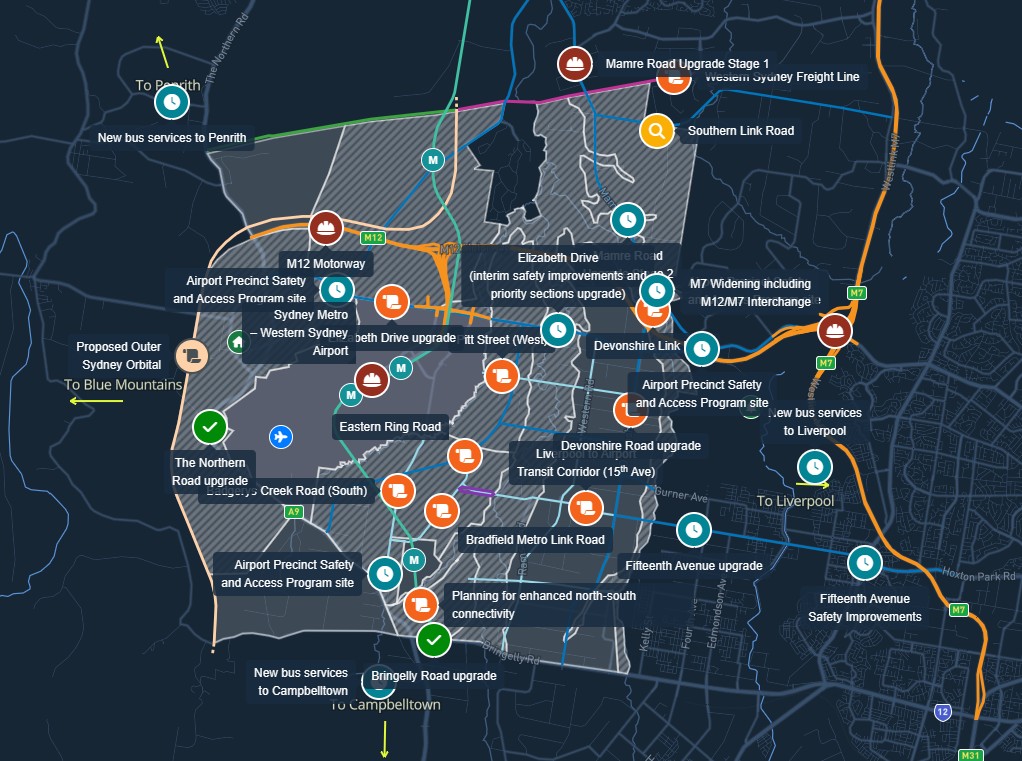
Western Sydney Airport Precinct interactive map.
Source: https://caportal.com.au/tfnsw/western-sydney-airport-precinct/map
Getting to and from WSI has been a common concern. Here is where things stand right now.
By road: The M12 Motorway is a 16-kilometre, toll-free road linking Elizabeth Drive to The Northern Road via the airport. It opens on 14 March 2026. That is this week. The M7 interchange at Cecil Hills follows mid-year. This gives drivers from Western Sydney a direct, fast route to the terminal.
By bus: Free interim bus services connect the airport to Penrith, Oran Park, Campbelltown, Liverpool, Mount Druitt and Leppington. Services run every 30 minutes between 4:30am and midnight (or 1am on weekends). The NSW Government confirmed these buses will be free until the metro opens.
By train: The Sydney Metro – Western Sydney Airport line is still under construction and is now expected to open in 2027, not alongside the airport. It will run from St Marys through Orchard Hills, Luddenham and Bradfield to the terminal.
Key takeaway: road and bus access are ready for opening. Rail comes later. Buyers in transit-dependent suburbs should factor in the metro timeline.
What Is the Western Sydney Aerotropolis?
Western Sydney Aerotropolis
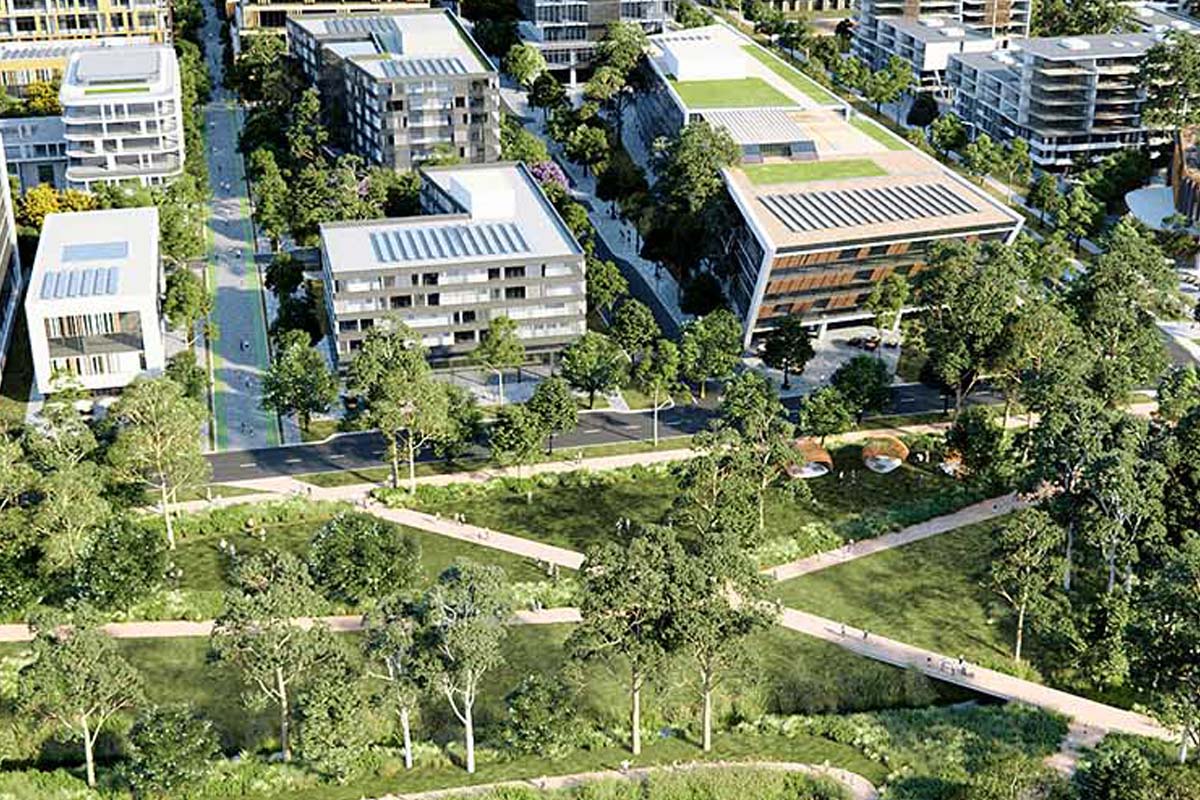
The airport does not exist in isolation. Around it, a whole new city is being built.
The Western Sydney Aerotropolis is a major employment and industry precinct covering land adjacent to the airport. At its centre is Bradfield City Centre. It is described as Australia’s first new city in over 100 years. This is planned to deliver 10,000 homes and 20,000 jobs on its own.
Across the full Aerotropolis, the NSW Government is projecting more than 120,000 jobs in industries like advanced manufacturing, aerospace, defence, logistics and research.
Investment is already moving in. Just a while ago, a $1 billion automated distribution centre for Aldi was approved within the Aerotropolis, set to create 3,700 construction jobs and around 585 ongoing roles. Since 2023, the NSW Government has approved seven projects worth over $1.9 billion in the precinct, with a further 25 worth more than $5.8 billion in the pipeline.
This is not speculative. The jobs are being approved now.
Which Suburbs Are Worth Paying Attention To?
The airport’s property impact is already playing out in some suburbs. In others, the full effect is still working its way through.
Here is a breakdown of the key areas to watch:
| Suburb | Why It Matters | Consideration |
| Bringelly | Adjacent to airport and Bradfield City Centre | Median prices jumped from $935,000 to $3,700,000 over the development period |
| Luddenham | Within Aerotropolis, new business parks being built | Industrial and residential development underway |
| Oran Park | Popular with first-timers, good transport links | Established community, strong buyer demand |
| Leppington | Bus connections to airport, off-the-plan growth | Transit-reliant until metro opens in 2027 |
| Penrith | 25km from airport, median house price around $1,100,000 | More affordable entry; airport effect is a long-term play |
| Campbelltown | Median around $975,000, bus route to airport confirmed | Affordability relative to broader Sydney market |
Properties closest to the airport have already moved significantly. Suburbs a little further out (Penrith, Campbelltown, Liverpool) are where the growth story is still unfolding.
Suburb median prices are sourced from CoreLogic and PropTrack data and reflect the latest available figures as at March 2026. Property values in the Western Sydney Airport corridor are moving quickly. Figures should be treated as a guide and verified before making any purchasing decisions.
What About the Flight Path?
This is the question that comes up most. The short answer: it depends on where you are.
Suburbs most affected by flight paths include parts of Mount Druitt, Penrith, Prospect, Orchard Hills, Bankstown, Windsor and Richmond. The Blue Mountains will also see some aircraft noise, though generally at higher altitude.
Research from the University of Sydney has found that properties directly under flight paths tend to trade at a three to five per cent discount compared to similar properties nearby. That gap is real and worth knowing about before you buy.
The flip side is that proximity to employment, transport and the airport itself can offset some of the noise discount. Property experts are split on the long-term net effect. Some point to the Inner West, where flight path discounts diminished over time as the area gentrified. Others are more cautious.
Worth knowing before you buy: check whether the property sits under a confirmed flight path, not just near the airport. The NSW Government has an Aircraft Overflight Noise Tool on the official WSI flight paths site where you can check your address.
What Does This Mean for Property Values?
Infrastructure of this scale takes time to fully price in. Here is what we know.
Suburbs immediately around the airport have already repriced. Bringelly is the clearest example. But many of the surrounding suburbs (Penrith, Liverpool, Campbelltown) still offer entry points that reflect Western Sydney affordability rather than airport proximity.
Western Sydney house prices are sitting below the Sydney median by a wide margin. Campbelltown is around $965,000. Penrith is around $880,000. The Sydney-wide median house price is sitting near $1.59 million as of early 2026, with forecasts of 5 to 7 per cent growth by year end, according to Domain and KPMG.
Employment is the thing to watch. Deloitte Access Economics found the airport region could support between 12,645 and 19,982 jobs by 2031. With 200,000 jobs projected across the Aerotropolis long-term, demand for housing within commuting distance of the precinct will only grow.
Do not bank on it happening overnight. The metro does not open until 2027. Full Aerotropolis buildout is a decades-long project. But the infrastructure foundation is being laid now, and buyers getting in before the precinct matures are taking on less speculation than they might think.
What Should Buyers Do Before Purchasing Near the Airport?
A few things are worth checking before you commit.
Flight path: Use the NSW Government’s overflight noise tool to confirm whether the property sits under an active flight path. WSI operates curfew-free, which means planes through the night.
Zoning: The Aerotropolis precinct has its own planning controls, and zoning around the airport is still being updated as master plans are approved. What is zoned residential today might be adjacent to a future industrial or commercial precinct. Checking the zoning report before you buy is just good sense.
Transport timeline: If you are relying on the metro, it is not opening with the airport. The free bus services are the main public transport option until 2027.
Long-term horizon: Buyers closest to the employment precincts stand to gain the most, but the growth story here is measured in years, not months.
A Check This Property zoning report will show you exactly what planning controls apply to any NSW property, including those in and around the Aerotropolis and Western Sydney Airport corridor. Use the map to see where the new airport is relative to any suburb you are researching.